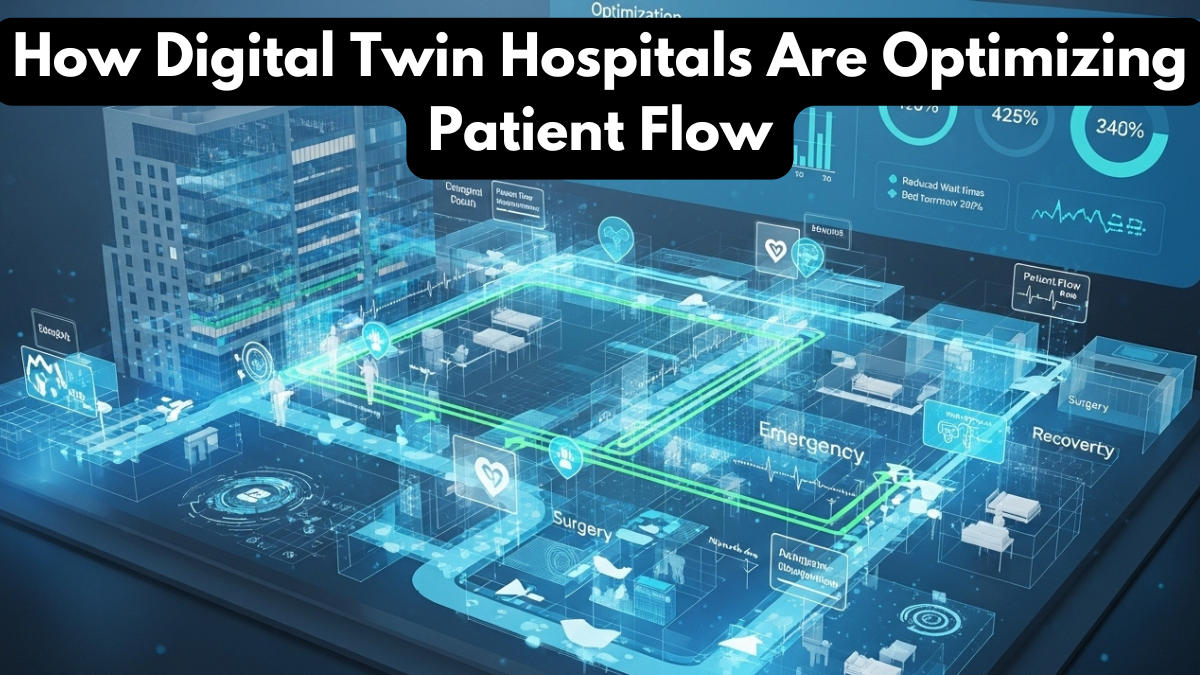
Healthcare systems worldwide are under growing pressure from rising patient volumes, staff shortages, and complex operational demands. In response, digital twin hospitals are emerging as a transformative solution that allows healthcare providers to model, test, and optimize hospital operations in a virtual environment. A digital twin is a real-time digital replica of a physical hospital, continuously updated with live data. By using healthcare simulation, hospitals can visualize patient movement, resource usage, and workflow bottlenecks before they impact real patients. As the demand for higher efficiency and smarter capacity planning increases, digital twin hospitals are becoming a cornerstone of modern healthcare innovation.
The Role of Healthcare Simulation in Patient Flow Optimization
At the heart of digital twin hospitals lies advanced healthcare simulation technology. These simulations replicate patient journeys from admission to discharge, accounting for variables such as staffing levels, equipment availability, and emergency surges. By running multiple scenarios, hospitals can identify delays and test improvements without disrupting real operations. Healthcare simulation allows decision-makers to experiment safely, improving efficiency while reducing operational risks. When integrated into digital twin hospitals, simulation models become continuously smarter, adapting to real-time data and supporting more accurate capacity planning decisions.
Capacity Planning Through Real-Time Digital Models
Effective capacity planning has long been a challenge for hospitals, especially during seasonal spikes or public health emergencies. Digital twin hospitals address this by providing a dynamic view of bed occupancy, operating room usage, and staff deployment. With real-time insights, administrators can anticipate demand rather than react to shortages. Capacity planning powered by digital twins helps balance workloads, reduce overcrowding, and improve patient experience. By aligning capacity planning strategies with healthcare simulation outputs, hospitals achieve higher efficiency while maintaining care quality.
The table below shows how digital twin hospitals improve operational planning compared to traditional methods:
| Operational Area | Traditional Hospital Planning | Digital Twin Hospitals |
|---|---|---|
| Patient Flow | Manual tracking | Real-time simulation models |
| Capacity Planning | Historical averages | Predictive, data-driven |
| Resource Allocation | Reactive decisions | Proactive optimization |
| Operational Efficiency | Limited visibility | Continuous efficiency gains |
Improving Efficiency Across Clinical and Administrative Functions
One of the most measurable benefits of digital twin hospitals is improved efficiency across both clinical and administrative functions. By simulating workflows, hospitals can streamline admissions, reduce wait times, and optimize staff schedules. Healthcare simulation identifies redundant steps and underutilized resources, enabling targeted improvements. Administrative teams also benefit from clearer insights into billing cycles, discharge planning, and interdepartmental coordination. When digital twin hospitals align efficiency goals with accurate capacity planning, they create smoother operations that benefit patients and staff alike.
Why Hospitals Are Rapidly Adopting Digital Twin Technology
The adoption of digital twin hospitals is accelerating as healthcare systems seek resilience and scalability. Aging populations, chronic disease management, and emergency preparedness require smarter operational tools. Healthcare simulation offers hospitals the ability to prepare for multiple scenarios, from daily fluctuations to large-scale crises. With improved capacity planning, hospitals can expand services confidently without overextending resources. The resulting gains in efficiency make digital twins a compelling investment, especially for large medical centers aiming to future-proof their infrastructure.
Conclusion: The Future of Digital Twin Hospitals
The evolution of digital twin hospitals represents a significant shift in how healthcare operations are managed. By integrating healthcare simulation, real-time data, and predictive analytics, hospitals can optimize patient flow with unprecedented precision. Enhanced capacity planning and sustained efficiency improvements translate into better care outcomes and more resilient systems. As healthcare continues to face complexity and uncertainty, digital twin hospitals offer a scalable, intelligent approach to delivering high-quality care in an increasingly demanding environment.
FAQs
What are digital twin hospitals?
Digital twin hospitals are virtual replicas of physical hospitals that use real-time data to simulate and optimize operations.
How does healthcare simulation help patient flow?
Healthcare simulation models patient journeys and workflows, helping hospitals identify bottlenecks and improve flow.
Why is capacity planning important in hospitals?
Capacity planning ensures that beds, staff, and resources are available when needed, reducing overcrowding and delays.
How do digital twin hospitals improve efficiency?
They provide real-time insights that streamline workflows, reduce waste, and enhance overall efficiency.
Are digital twin hospitals only useful for large hospitals?
No, hospitals of various sizes can benefit from digital twin hospitals by improving planning and operational decision-making.
Click here to learn more